
Introduction
There are two temporomandibular joints, commonly referred to as the TMJ, both arising from either side of the jaw bone, the mandible, with articulations between the condylar head and the fossa in the temporal bone. This joint allows us to talk, chew, yawn amongst other things making it one of the most important joints in the human body.
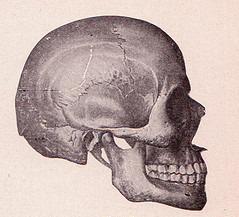
There are many problems that can arise from TMJ problems, with 80-90% having a slipped articular disc that lies between the mandible and the temporal bone. Problems with the TMJ gives rise to many signs and symptoms amongst which include headaches and pain in the muscles of the head and neck, but often a headache can be misdiagnosed by a doctor and thus recieving the wrong treatment, which can in the long-term potentiate the problem further.
| Human skull image courtesy of https://www.flickr.com/photos/perpetualplum/3935841805/ under creative commons licence. |
|
Banner adapted from: https://commons.wikimedia.org/wiki/File:Mandibule.jpg Public domain image. |
News
'Jaw bone created from stem cells'
Dr Gordona Vunjak-Novakovic from Columbia University used stem cells taken from bone marrow to create the temporomandibular joint in the lab. They hope they could use this to graft in defects in people suffering from TMJ problems and tranform the way they carry out reconstruction work. Dr Vunjak-Novakovic also believes other bones in the head and neck can also be created using their technique.
'Tiny gene changes means big differences in pain'
Jon-Kar Zubieta and his team at the University of Michigan discovered that tough guys and whimps carry different forms of a gene related to dopamine, the COMT gene. Volunteers used in this study were given salt water injections directly into the TMJ and recorded the individual's own pain responses every 15 seconds.
'Dentistry caused rare syndrome'
A girl from East Sussex suffered from TMD after having two teeth removed and a brace fitted in at the age of 11. She suffered from many common symptoms associated with TMJ problems.