
Treatment
Before a treatment plan is laid out for a patient suffering from TMD, first the medical or dental professional performs various diagnostic tests which may include x-rays, MRI and CT scans.
Once TMD is diagnosed various treatment plans are offerered, these include:
- Ice packs, the cold ice packs help relieve the pain and help reduce muscle spasms. Others find that a routine of moist heat, exercise and ice also helps TMD symptoms. This can be done by first applying moist heat to the side of your face and temple. This relaxes tight muscles that may be causing spasms. Try to do this for about 10 minutes. Then do a few simple stretching exercises, like this one:
- Put your left thumb under your upper front teeth.
- Put your right index and middle fingers on top of your lower front teeth.
- Gently pull the jaw apart using your hands, not your jaw muscles.
Followed by applying an ice pack to the side of the face.
An extensive video of TMJ exercises can be seen from the video below, consult a dentist if problems persist and your dentist may also recommend other exercises.
- Medications such as NSAIDS are commonly taken by patients.
Over the counter medicines which include ibuprofen and naproxen can help in not only temporarily releaving pain or discomfort but also help in reducing inflammation which will aid the healing process. However, if necessary the doctor or dentist can prescribe stronger pain or anti-inflammatory medications. Muscle relaxants, such as diazepam (Valium), aid in decreasing muscle spasms, antianxiety drugs which helps relieve stress, which is sometimes thought to make TMD worse, can also be prescribed. Narcotic medications may also be prescribed, but their actual affects and whether they help aid in healing are not very well  know and so is the reason why their rarely prescribed. Corticosteroid shots straight into the TMJ to treat inflammation may also be used.
75-90% of patients suffering from TMJ disorders tend to opt for the over the counter medicines such as ibuprofen, however this is not a cure and will only relieve the pain.
|
Drug image courtesy of https://www.flickr.com/photos/draconianrain/1427632177/ under the creative commons license. |
- Mouth guards can be used as splints to protect teeth from bruxism. This can be arranged by visiting a dentist. These are designed to fit over the teeth and help in preventing the upper and lower teeth coming together, making it difficult to clench your
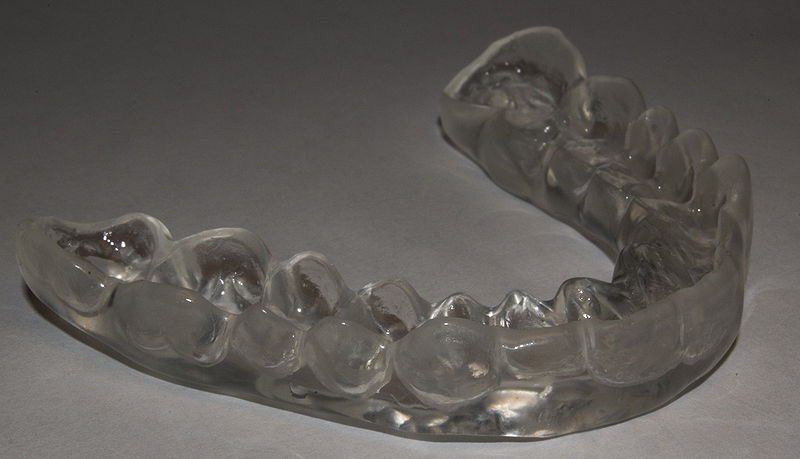 teeth. These devices are constructed as to help relieve the pressure off the joint and muscles and help aid to heal. If when earing the mouth guard discomfort is potentiated, the mouth guard should be discontinued and seek your dentist for further information.
|
Mouth guard image courtesy of https://commons.wikimedia.org/wiki/File:Bettskena.jpg. The image is in the public domain and thus free of any copyright restrictions. |
Other tips include:
- Yawn and chew as little as possible
- Avoid singing and yelling
- Sleep on your back and not your stomach
If all else fails surgery is reccommended as a last resort, TMJ arthroscopy, ligament tightening, joint restructuring, and joint replacement are considered in the most severe cases of joint damage or deterioration. Various different operations can be done, depending on the individual's situation.
There is no definative treatment and there is no definative evidence from research trials that they work or are even a cure, but many people find these treatments useful. If symptoms persist, be sure to visit your dentist.